
Rose Creek Elementary Wellness and Prevention Plan 26-27
Our school’s mission is to ensure that ALL students & Staff LEAD and LEARN at high levels. The school and community are dedicated to teaching, serving and meeting the needs of all students. High standards of academics and behavior enable Rose Creek students to achieve their full potential.
This plan supports this mission by helping students who may need additional support. We prioritize prevention by offering our students and their families various services and support.
Student Wellness & Prevention Plan
Prevention Overview:
Research shows that addressing behavior and wellness concerns before they occur is much more effective than trying to stop them after they start. These proactive efforts are our primary prevention strategies. These strategies focus on the root causes, like enhancing protective factors and decreasing risk factors, strengthen well-being and help students build resilience to thrive. They act as buffers against risk and promote resilience, healthy development, and positive outcomes. Risk factors are conditions that increase the likelihood of academic, behavioral, or mental health difficulties. Our school supports student development of Utah State Board of Education’s five protective factors represented by the graphic below; more information about these protective factors can be found using this link.
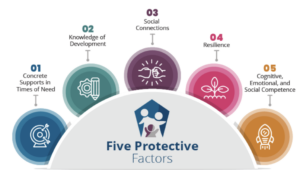
Our school supports student wellness by prioritizing primary prevention practices that are centered on building protective factors and promoting positive, intentional social, emotional, academic, and behavioral development for all students. This prevention plan includes universal strategies (for all students) as well as targeted strategies (for small groups or a few students) for each section below.
Student Engagement & Attendance:
Our school believes that attendance directly impacts academic achievement, social development, and future success. Attendance also reflects a student’s sense of belonging. Some of the efforts our school prioritizes to encourage student engagement and promote attendance are listed below:
- Our school uses Panorama early warning system to identify students who may be at risk of disengagement or absenteeism, which allows us to proactively support students in feeling connected and engaged at school.
- Our school staff cares about our students and is committed to getting to know them to help them feel a sense of belonging.
- Our school creates frequent opportunities for students to connect with each other, build friendships, and feel a sense of belonging with their peers during class, at recess and lunch, and throughout their day.
- Our school staff monitors attendance using the District dashboard and notifies parents of absences.
- Our school has an attendance coalition composed of teachers and administrators to review student attendance and plan and present faculty professional development to improve attendance.
- Our school administrators send information regarding the importance of attendance and how the school can support students who have a difficult time coming to school.
- Our school counselor sends invitations for lunch bunch groups to students who struggle with attendance.
- Our school offers volunteering options for students. In fifth-grade, you can become a buddy for our students in the Autism Support Classrooms. In sixth-grade you can be on the Inclusion Team to teach about inclusion and what Autism is and how to support students who are neurodiverse. Sixth-graders can also apply to be a student leader to help with announcements, assemblies, and plan schoolwide events.
- To help promote student belonging, each month teachers select one student as the student of the month. Students are announced, along with the reason they were chosen, and post cards are sent home.
Social, Emotional, and Behavioral Well-Being:
Our school prioritizes prevention by offering support and services to our students and their families. Some of our everyday efforts, including the systems and strategies for supporting our students, are listed below:
- Our school staff supports students’ skill development by clarifying behavioral expectations in all spaces throughout our school, proactively teaching these behaviors, addressing root causes of behavioral concerns, supporting student wellness, and consistently modeling and reinforcing appropriate behavior.”
- Our school rules are to ROAR like a Raptor:
- Respect
- Own Your Actions
- Act Safely
- Ready to Learn
- Our school staff support students who are following the rules by reinforcing positive rewards.
- Our school participates in social-emotional learning by using Move This World at least once a week.
- Our school follows Stop-Walk-Talk during recess to encourage students to work through disagreements or issues outside. If students are unable to resolve concerns, they can discuss their issues with the adults on recess duty.
- Our students have access to our Student Wellness Room, “The Nest”. This is a space students can go to regulate their behavior and emotions.
- Our school Multi Tiered System of Support Team (MTSS) meets monthly to discuss student behavior and review their data. This team is composed of school administrators, an instructional coach, a school counselor, and two teachers.
- The MTSS Team discusses the use of our school-wide rules and makes adjustments as needed.
- MTSS plans and reviews data from the school-wide positive reward system.
- MTSS Team provides professional development to faculty and staff regarding student behavior and positive rewards.
- MTSS reviews school's use of Move This World to ensure it’s being taught at least once a month.
- Our school uses Panorama data management to identify students in need of additional support and proactively meet their needs.
- Our school provides access to District mental health and support resources through Student Services, which includes the Jordan Family Education Center and Mental Health Access Program.
- Our school provides access to academic support with District departments to support the success of every student.
- Our school’s mental health and student support providers (school counselors, school psychologists, clinical support, etc.) are trained and supported by District administration to follow current best practices in prevention and intervention efforts.
- Our school intervenes with early warning, content monitoring, and anonymous reporting tools with support from District specialists to identify and support students who may be at risk.
- Our school provides access to parent and family resources, including a District partnership with the Cook Center for Human Connection’s Parent Mental Health Series platform which is shared with parents monthly through Parent Square and District web content.
- Our school invites parents to the school to participate in various activities such as grade-level programs, PTA-sponsored events (lunch bunch, fundraiser, book fair), and class activities.
Suicide Prevention
- Our school’s mental health providers and administrators are trained on and review District suicide risk intervention guidelines annually with support from Jordan District’s Student Services Team.
- Our school’s licensed staff participate in suicide prevention training as part of their license renewal.
- At Back to School night, we have resources for parents regarding Safe-UT. The resource remains in the lobby throughout the year.
- All of our District’s staff participate in an annual crucial concerns training to maintain employment in the District, which covers topics such as suicide, bullying, and violence prevention.
- Students identified who may be at risk of suicide receive interventions and support in partnership with their parents and guardians, appropriate to their individual needs. This may include a screening interview, parent/guardian collaboration, a safety plan, mental health recommendations/referrals (Jordan Family Education Center, Mental Health Access Program, etc.), a re-entry meeting, and regular follow-up.
- Our school prioritizes early intervention and utilizes several District supported tools to support student wellness when needed. These tools include content monitoring on student’s school accounts to respond to concerning content, SafeUT anonymous reporting for students to express concerns, and early warning data system through Panorama.
- Our school counselor teaches a monthly lesson in every classroom. She teaches the students that she is a safe person for every student to turn to if they need help.
- Our school uses the social, emotional, well-being curriculum Move This World
- Faculty and staff are trained yearly on phrases to listen for and when to immediately get support from our school counselor, school psychologist, and administrators.
- When a report is made the administrator of schools, school administration, the school psychologist, and school counselor are all notified. The school administrator takes the lead and assigns the report to a team member. School administrators and the school mental health team review the process and outcome at their weekly meetings.
Bullying Prevention
- At Back to School night, we have resources for parents regarding Safe-UT. The resource remains in the lobby throughout the year.
- Our school team proactively reviews relevant data on school climate, safety, and bullying by identifying vulnerable populations (e.g., racial and ethnic groups, LGBTQ youth, students with disabilities) and specific spaces where bullying may be likely to plan support accordingly.
- Our school’s staff is trained on school procedures for recognizing, reporting (SafeUT, content monitoring, etc.), and responding to bullying incidents. When a report is made the administrator of schools, school administration, the school psychologist, and school counselor are all notified. The school administrator takes the lead and assigns the report to a team member. School administrators and the school mental health team review the process and outcome at their weekly meetings.
- The school's mental health team discusses student concerns and creates plans for students at their weekly meeting.
- All of our District’s staff participate in an annual crucial concerns training to maintain employment in the District which covers topics such as suicide, bullying, and violence prevention.
- Students involved in incidents of bullying as targets, aggressors, or witnesses receive support for their individual needs which may include suicide risk assessments, counseling and mental health services, Functional Behavior Assessment (FBA), Behavior Intervention Plan (BIP), a student wellness plan and/or parent/guardian contact—recognizing that targets, aggressors, and witnesses of bullying are more susceptible to school issues.
- Our school’s administrators have been trained on Bullying Action Planning through the District Wellness Team and continue to implement best practices in bullying intervention, with the overall goal of prevention.
- Our school prioritizes early intervention and utilizes several District supported tools to support student wellness when needed such as content monitoring on student’s school accounts to respond to concerning content, SafeUT anonymous reporting for students to express concerns, and early warning data system through Panorama.
- Students are often referred to the school counselor and/or school psychologist to learn self advocacy skills, conflict resolution skills, problem solving skills, communication skills and to build positive connections with an adult and peers.
- Our school teaches the Move This World social emotional learning curriculum schoolwide.
- Our school counselor teaches schoolwide guidance lessons on building a positive school community, recognizing bullying, using STOP,WALK, TALK, and solving conflicts with problem solving skills and empathetic communication.
- There are Stop-Walk-Talk posters on every exit to remind students of the procedures as they exit for recess.
- Our school counselor and school psychologist run friendship groups where students learn problem-solving, conflict resolution, and communication skills.
- If students participate in bullying, they will be spoken to by an administrator and complete a reflection packet on which rule was broken, how it affected the other student(s), what they should have done, and make a plan for future situations. This is also reported to the parents/guardians of both the victim and perpetrator.
Violence Prevention Plan
- Our school’s administrators are trained on the Comprehensive School Threat Assessment Guidelines (C-STAG).
- Our school has a process for timely response to school threats using Comprehensive School Threat Assessment Guidelines (C-STAG) and its decision tree. This includes warning potential victims and their parents/guardians.
- Our school’s staff and students are aware of school procedures for recognizing and reporting (SafeUT, content monitoring etc.) threats of violence. Our counselor does teach each class how to recognize the size of the problem and who to go to when adult help is needed.
- Safe UT posters are displayed in upper grades hallways, outside of our wellness room and the school counselors office. Every teacher was given a Safe UT table tent. Flyers are also available to parents at back to school night, and in our school’s entrance lobby.
- Students who are affected by or who make threats of violence receive interventions that proactively support students by building skills, meeting needs, and problem solving that aligns with the school’s universal strategies. Students receive support appropriate to their individual needs which may include problem-solving, interviews, suicide risk assessments, Functional Behavior Assessment (FBA), Restorative Conferencing, Mediation, a Behavior Intervention Plan (BIP), counseling and mental health services, a student wellness plan and/or parent/guardian contact.
- Our school prioritizes early intervention and utilizes several District supported tools to support student wellness when needed: content monitoring on student’s school accounts to respond to concerning content, SafeUT anonymous reporting for students to express concerns, and early warning data system through Panorama.
- All of our District’s staff participate in an annual crucial concerns training to maintain employment in the District which covers topics such as suicide, bullying, and violence prevention.
- Our school counselor teaches a monthly lesson to each class to discuss conflict resolution.
- Our school provides instruction to students who have used violence or aggression to communicate needs. Our school counselor and school psychologist make plans to help students learn better ways of communicating and meeting their needs.
- Our school uses research-based interventions for students who show signs of aggression in order to help teach these skills to students who might lack them. Changing these behaviors early on reduces the risk of violence in our school.
- Our school strives to build a sense of community with our pro-social program, Move This World. Our teachers and staff teach social skills as part of our tier 1 instruction in order to help students develop various ways of meeting their needs and receiving help.
- If students participate in violent behavior, they will be spoken to by an administrator and complete a reflection packet on which rule was broken, how it affected the other student(s), what they should have done, and make a plan for future situations. This is also reported to the parents/guardians of both the victim and perpetrator.
Please contact our administration for questions regarding our plan.